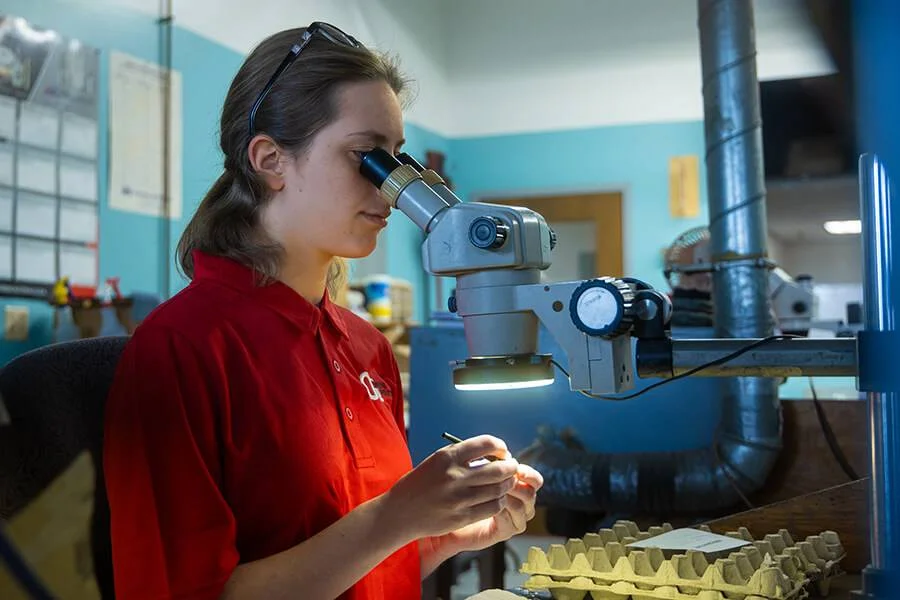
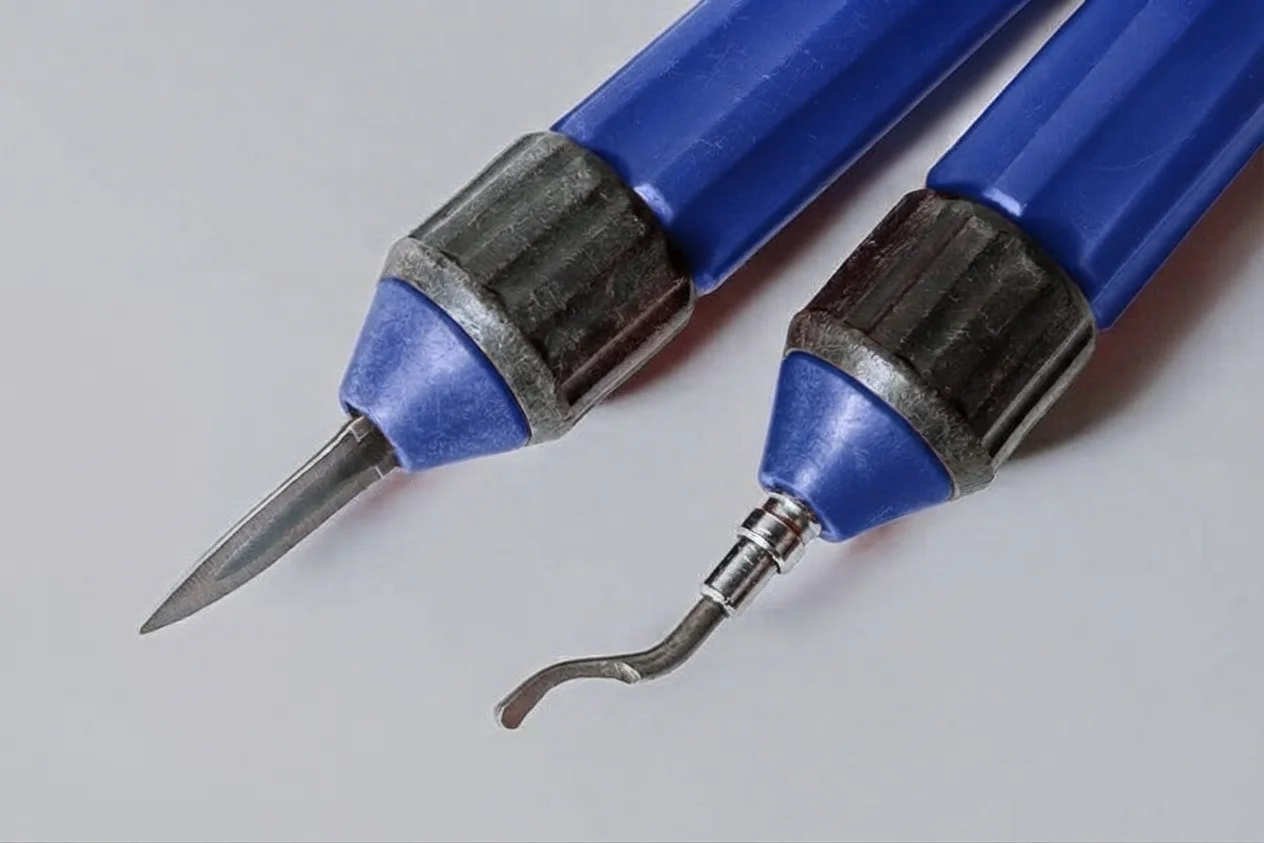
Though deburring can be a fairly simple task, Koham considers it to be an important one. In our deburring department alone, we have employees who have been with us for 10+ years. Each Koham’ deburring tech undertakes the microscopic deburring of complex projects with unparalleled attention to detail. And we’ve developed special finishing compounds for mirror finish polishing and solutions for Electro Polishing. Why call the number of anyone else?
Contact Koham Industries for available deburring part services. Our precision techniques ensure we can work on even the most problematic parts.
CNC deburring, essential in precision machining, addresses the challenge of burrs left on workpieces after CNC machining. Manual CNC deburring involves hand tools like brushes or files, ideal for intricate parts or small batches. Automated CNC deburring uses machines or robots with grinding wheels or abrasive tools, and is more efficient for high-volume production, ensuring both speed and consistency.
The significance of CNC deburring lies in improving fit, functionality, and safety. Deburring ensures precise assembly by eliminating burrs that might hinder components’ fit or operation. Additionally, the process enhances safety by removing sharp edges, contributing to overall quality and meeting safety standards.
CNC deburring’s impact extends beyond functionality to aesthetics, providing a smoother surface finish that is crucial in industries where visual appeal is a high priority. Deburring is a versatile practice applicable to various materials and industries, promoting long-term cost-efficiency despite initial setup costs.
Why Choose Koham Industries for Micro Deburring?
Koham Industries is your choice for microdeburring services, driven by a commitment to precision and innovation. Our deburring department, with professionals boasting over 10 years of experience, ensures meticulous attention to detail in the microscopic deburring of complex projects. Utilizing cutting-edge technology, we guarantee a mirror finish for each machined part.
In contrast to automated processes, Koham Industries excels in by-hand deburring services, where precision and accuracy are required. Our comprehensive quality control ensures every workpiece meets required standards, minimizing defects and maximizing customer satisfaction. Choose Koham Industries for microdeburring and elevate your expectations for precision and performance.
By-Hand Deburring Services
Normal CNC shops use machines to complete their deburring and polishing processes, resulting in machined parts with rough edges and tiny, uncleaned holes. The CNC machines at Koham Industries are anything but “normal.” We know deburring is as important of a process as the machining itself. For the highest precision, attention to detail and accuracy must be applied from the start of a job to its completion.
Koham Industries has applied this attention to detail to every component machined in our Wisconsin facility. Our deburring department has 30 X Power Magnification Microscopes at every deburring station, backed by trained employees skilled in microdeburring.
Deburring, or the process of removing burrs or rough edges from the surface of a workpiece, offers several benefits.
Improved fit and function
Burrs can cause issues with the fit and function of a workpiece, such as difficulty in assembling parts or interference with other components. Removing burrs ensures the workpiece fits and functions properly.
Enhanced safety
Burrs can be sharp and potentially dangerous, especially on components that are handled frequently. Removing burrs helps to reduce the risk of injury and improve the overall safety of the workpiece.
Increased efficiency and productivity
Burrs can cause delays in production and increase the time and effort required to assemble and use a workpiece. Removing burrs can help to streamline the manufacturing process and increase efficiency and productivity.
Improved appearance
Burrs can negatively impact the appearance of a workpiece, making it look unfinished or unprofessional. Removing burrs helps to improve the overall appearance of the workpiece and enhance its visual appeal.
Enhanced quality control
Removing burrs is an important step in the quality control process, as it helps to ensure the workpiece meets the required standards and specifications. This can help to reduce the risk of defects and improve customer satisfaction.
Types of Burrs
Several types of burrs can occur on the surface of a workpiece as a result of machining or other manufacturing processes.
External burrs
Burrs that protrude from the surface of the workpiece and can be felt with the fingers. External burrs are typically the easiest to remove and are often removed using hand tools or automated deburring equipment.
Internal burrs
Burrs that are located inside a hole or opening in the workpiece and are not visible from the outside. Internal burrs can be more difficult to remove and may require specialized deburring tools or techniques.
Edge burrs
Burrs that occur on the edges of the workpiece and are often caused by cutting or grinding processes. Edge burrs can be difficult to remove and may require deburring tools with fine or flexible points to access the burr.
Fillet burrs
Small, rounded burrs that occur at the corners or edges of the workpiece. Fillet burrs are often caused by the use of high-speed cutting tools and may be difficult to remove without damaging the surrounding material.
Flank burrs
Burrs that occur on the flanks, or sides, of the workpiece. Flank burrs are typically caused by the use of high-speed cutting tools and can be difficult to remove without damaging the surrounding material.
Materials
Common Materials We Deburr
Koham Industries excels in deburring services with extensive experience in treating parts made from various materials. Our expertise covers a range of materials commonly used in manufacturing.
Alloy Steel
Alloy steels include additional elements beyond carbon, which improve their hardness, toughness, and resistance to fatigue and wear. These steels are widely used in construction, automotive, and machinery due to their enhanced properties.
Alloy Steel
UNS Designation
DIN Designation
ISO Designation
4140
1.7225
708M40
42CrMo4
4340
1.6565
817M40
40NiCrMo6
8620
1.6523
805M20
20NiCrMo2
52100
1.3505
100Cr6
SUJ2
4142
1.7227
708M40T
41CrMoS4
6150
1.8159
735A51
50CrV4
Aluminum
Aluminum alloys are lightweight and strong, with excellent thermal and electrical conductivity. They are also resistant to corrosion and can be anodized for added protection, making them ideal for aerospace and packaging industries.
Aluminum Alloy
UNS Designation
DIN Designation
ISO Designation
7075-T651
3.4365
76528
AlZn5.5MgCu
6082-T651
3.2315
64430
AlSi1MgMn
6060
3.3206
EN AW-6060
AlMgSi
5052
EN AW-5052
3.3523
AlMg2,5
2017A
3.1325
24530
AlCu4MgSi
Brass
Brass is a metal known for its easy machinability and good electrical conductivity. It is ideal for applications requiring low friction, such as gears, locks, and musical instruments.
Brass
UNS Designation
DIN Designation
Alternative Designation
C36000
UNS C36000
CUZN39PB3
CuZn39Pb3
C46400
UNS C46400
CuZn38Al
Naval Brass
C93200
UNS C93200
Saems 660
Bearing Bronze
C48500
UNS C48500
CuZn39Sn1
Leaded Muntz Metal
C26000
UNS C26000
CUZN30
Cartridge Brass
C37700
UNS C37700
CUZN40PB2
Forging Brass
Copper
Copper is excellent at conducting heat and electricity, making it perfect for electrical uses like busbars and wire connectors. It is easily recognized by its shiny reddish-orange color and is also used in plumbing and roofing.
Copper
UNS Designation
DIN Designation
Alternative Designation
C11000
UNS C11000
Cu-ETP
Electrolytic Tough Pitch (ETP) Copper
C10100
UNS C10100
OF-OK
Oxygen-Free Electronic (OFE) Copper
C10200
UNS C10200
OF-Cu
Oxygen-Free (OF) Copper
C28000
UNS C28000
CuZn40
Muntz Metal
C14500
UNS C14500
TeCu
Tellurium Copper
Hastelloy
Hastelloy is a group of nickel alloys known for their high resistance to corrosion, pitting, and stress-corrosion cracking. They are often used in harsh environments like chemical processing and aerospace, where durability is crucial.
Hastelloy
UNS Designation
DIN Designation
Alternative Designation
C276
UNS N10276
2.4819
NiMo16Cr15W
C22
UNS N06022
2.4602
NiCr21Mo14W
B-2
UNS N10665
2.4617
NiMo28
X
UNS N06002
2.4665
NiCr22Fe18Mo
C2000
UNS N06200
2.4675
NiCr23Mo16Cu
G-30
UNS N06030
2.4603
NiCr29Mo9Fe
Inconel
Inconel is a strong, corrosion-resistant nickel alloy, ideal for challenging aerospace applications. It can withstand extreme temperatures and pressures, making it suitable for jet engines and gas turbines.
Inconel
UNS Designation
DIN Designation
Alternative Designation
718
UNS N07718
2.4668
NiCr19Fe19Nb5Mo3
625
UNS N06625
2.4856
NiCr22Mo9Nb
600
UNS N06600
2.4816
NiCr15Fe
X-750
UNS N07750
2.4669
NiCr15Fe7TiAl
601
UNS N06601
2.4851
NiCr23Fe
725
UNS N07725
2.4668
NiCr19Fe19Nb5Mo3
Invar
Invar is a nickel alloy with very low thermal expansion, making it highly stable and perfect for precision applications such as instrumentation and aerostructure molds. It is also used in scientific instruments where dimensional stability is critical.
Invar
UNS Designation
DIN Designation
Alternative Designation
36
UNS K93600
1.3912
FeNi36
42
UNS K94200
1.3917
FeNi42
48
UNS K94800
1.3922
FeNi48
32-5
UNS K94610
1.3911
FeNi32-5
42-6
UNS K94620
1.3913
FeNi42-6
46
UNS K94630
1.3914
FeNi46
Maraging Steel
Maraging steels are ultra-high-strength steels that are easy to machine and weld without causing distortion. They gain their exceptional hardness and toughness from a special heat-treating process, making them suitable for aerospace and tooling applications.
Maraging Steel
UNS Designation
DIN Designation
Alternative Designation
200
UNS K93120
1.6359
20Ni Maraging Steel C200
250
UNS K92890
1.6358
18Ni Maraging Steel C250
300
UNS K93120
1.6354
18Ni Maraging Steel C300
350
UNS K93160
1.6356
18Ni Maraging Steel C350
400
UNS K91460
1.6352
Custom 465 Stainless
500
UNS K92810
1.6354
Custom Age 625 Plus
Stainless Steel
Stainless steel is known for its strength, heat, and corrosion resistance, along with its durability and attractive appearance. These qualities make it suitable for a wide range of uses, including kitchenware, medical instruments, and construction.
Stainless Steel
UNS Designation
DIN Designation
Alternative Designation
316L
UNS S31603
X2CrNiMo17-12-2
Stainless Steel 316L
304
UNS S30400
X5CrNi18-10
Stainless Steel 304
17-4 PH
UNS S17400
X5CrNiCuNb16-4
Stainless Steel 17-4 PH
303
UNS S30300
X8CrNiS18-9
Stainless Steel 303
420
UNS S42000
X20Cr13
Stainless Steel 420
440C
UNS S44004
X105CrMo17
Stainless Steel 440C
Titanium
Titanium is a lightweight metal with excellent strength, low thermal expansion, and high corrosion resistance. Its ability to be sterilized and its biocompatibility make it unique, especially in medical implants and aerospace components.
Titanium Grade
UNS Designation
DIN Designation
Alternative Designation
5 (Ti-6Al-4V)
UNS R56400
3.7165
Ti-6Al-4V
2
UNS R50400
3.7035
CP Titanium
23 (Ti-6Al-4V ELI)
UNS R56401
3.7165
Ti-6Al-4V ELI
9 (Ti-3Al-2.5V)
UNS R56320
3.7195
Ti-3Al-2.5V
7 (Ti-0.2Pd)
UNS R52400
3.7235
Ti-0.2Pd
12 (Ti-0.3Mo-0.8Ni)
UNS R53400
3.7105
Ti-0.3Mo-0.8Ni
Tool Steel
Tool steels are hard, stiff, and resistant to abrasion, making them perfect for manufacturing industrial tools. Their robustness is essential for cutting, drilling, and molding applications in various industries.
Choose Koham Industries for all your CNC machining needs. From discussing your design with our manufacturing engineers, through the advanced 5-axis or EDM machining process, to meticulous by-hand deburring, Kohamis completely dedicated to providing services with the highest precision results to clients worldwide.
What is deburring and why is it essential in CNC machining?
Deburring is a critical post-processing manufacturing step used to remove unwanted raised edges, burrs, and sharp corners left behind on a workpiece after machining operations like milling, drilling, turning, or laser cutting. It is essential because burrs can interfere with part assembly, cause premature mechanical wear, create safety hazards, and degrade the overall aesthetic and functional quality of the component.
What is the difference between automated deburring and manual (by-hand) deburring?
Manual (By-Hand) Deburring: Relies on skilled technicians using specialized hand tools, files, scrapers, or miniature power brushes. It offers unmatched precision and tactile feel, making it ideal for delicate, complex geometries, fragile features, and high-value custom parts where perfection is required.
Automated Deburring: Utilizes advanced machinery—such as mass finishing tumblers, robotic brushes, thermal deburring, or electrochemical processes—to process high volumes of parts quickly and economically with consistent repeatability.
What types of materials and parts benefit most from professional deburring?
Virtually all metals and high-performance plastics benefit from deburring, especially components used in mission-critical applications. Parts with internal channels, intricate threads, sharp cross-holes, and tight-tolerance aerospace, medical, or automotive components require meticulous deburring to ensure optimal fluid flow, proper sealing, and stress distribution without altering critical dimensions.
Can deburring affect the dimensional tolerances or surface finish of a precision part?
When performed by experienced technicians using controlled techniques, deburring targets only the microscopic burrs and sharp edges without compromising the part’s core dimensional tolerances. In fact, professional deburring improves the overall surface finish, reduces friction, eliminates stress concentration points, and prepares the metal or plastic surface for subsequent treatments like anodizing, plating, or passivation.
How do I know if my machined components require specialized deburring?
If your parts are subjected to high mechanical stress, high-pressure fluid dynamics, or strict aesthetic and safety standards, professional deburring is usually a necessity. You should review your part drawings for critical edge-break callouts (e.g., “break all sharp edges 0.1–0.3 mm”) and discuss your assembly requirements with your manufacturing partner to determine the most effective finishing method.